old germarn stove locks +254720062016
Beacons and German antiques Edition (The Iron Box)+254720062016
Some of the items that are mostly sought after are:
Iron boxes
Knives
Regoregos (This machine that was used to grinds grains)
Padlocks
Spoons
Chains
Vinyl players
fufumark
Hellars
Badges
Coins (Indian rupees, King George, Queen Elizabeth) although not all of
these coins are precious, only those of particular years are considered
valuable
The iron box
This iron box is considered as one of the most expensive, the iron box
is small in size, for it to iron clothes it used to be put on the sun
and the it gets hot throughout the whole day, it was able to iron
clothes for the next 2 or 3 days consecutively, this iron box is
perceived
Characteristics and specifications of a Genuine German Duss stove
It should have a logo of two lions standing upright and a palm tree
The palm tree should be between the lions
The palm tree MUST have five leaves on top
The year it was made should be indicated on it e.g. (1943)
It should have a serial number
Copper or Goldish in appearance
Turns a mirror to white or grey
Changes a blue or black pen to red
Burns steel wires
It should be magnetic
A portrait of a human being or wrist fists on one side
Turns warm or hot when shaken
It must have some liquids inside this can be noted when shaken
its weight must be indicated in pounds only i.e. Lbs.
Distorts wave’s signals e.g. radio or mobile phone
Critical tests
The mirror test is the most critical tests of all. If the antics turn
the mirror like its supposed to: the antique should not reflect in the
mirror it should make the mirror screen change to milky or some sought
of cloudy or though the mirror will return back to its normal state
after some time. The mirror test is the most important and if the
antique passes the mirror test only some buyers may definitely buy it.
+254720062016
German East Africa 1886-1918
TANGANYIKA as a geographical and political
entity did not take shape before the period of High Imperialism; it's
name only came into use after German East Africa was
transferred to Britain as a mandate by the League of Nations in 1920.
What is referred to here therefore is the history of the region that was
to become Tanganyika.
German CARL Peters had secured treaties with tribal leaders on East Africa's coast, providing the German government with legitimation to negotiate with Britain over spheres of interest in East Africa. In the treaty of 1886, Germany renounced it's claims on the WITU AREA (on Kenya's coast, north of Mombasa) and on Uganda, and Britain recognized Germany's claim to what was to become German East Africa. In another treaty of 1890, Germany traded the islands of Zanzibar and Pemba for the much smaller island of Heligoland, off Germany's coast in the North Sea. The Germans bought off the Sultan of Zanzibar's rights to the Tanganyikan coast for $ 800,000.
The German East Africa COMPANY (founded 1887, succeeded by the German government in 1891) established BAGAMOYO as their colony's capital, soon moving it to DARESSALAAM. The colony was called DEUTSCH-OSTAFRIKA (German East Africa). The colony's borders had been established in treaties with Britain (Kenya, Uganda, Northern Rhodesia), Belgium (Belgian Congo) and Portugal (Mocambique); interests of the indigenous people were disregarded. From the coast, the Germans penetrated the country and established their rule. The currency was 1 Rupia = 64 Pesa.
German CARL Peters had secured treaties with tribal leaders on East Africa's coast, providing the German government with legitimation to negotiate with Britain over spheres of interest in East Africa. In the treaty of 1886, Germany renounced it's claims on the WITU AREA (on Kenya's coast, north of Mombasa) and on Uganda, and Britain recognized Germany's claim to what was to become German East Africa. In another treaty of 1890, Germany traded the islands of Zanzibar and Pemba for the much smaller island of Heligoland, off Germany's coast in the North Sea. The Germans bought off the Sultan of Zanzibar's rights to the Tanganyikan coast for $ 800,000.
The German East Africa COMPANY (founded 1887, succeeded by the German government in 1891) established BAGAMOYO as their colony's capital, soon moving it to DARESSALAAM. The colony was called DEUTSCH-OSTAFRIKA (German East Africa). The colony's borders had been established in treaties with Britain (Kenya, Uganda, Northern Rhodesia), Belgium (Belgian Congo) and Portugal (Mocambique); interests of the indigenous people were disregarded. From the coast, the Germans penetrated the country and established their rule. The currency was 1 Rupia = 64 Pesa.
See also
Trade
For many years Tanzania was the world's leading producer of Sisal but the introduction of synthetic fibres depleted the market. Cashew nut and cotton, Pyrethrum
and tobacco are grown as well as Arabica coffee in Arusha district and
Robusta coffee in the Bukoba area. Tea is grown in the Usambara and
Tukuyu regions. Main timber products are camphorwood, mahogany
(mkangazi), mangrove, mninga, ebony (mpingo) and teak (mvule).
Diamonds, alluvial and ore gold are found near Shinyanga and the German 'Tabora Sovereign' was minted from Sekenke gold. The famous Tanzanite gemstone is known all over the world.
In British East Africa, the Indian Rupee replaced the Cowrie Shell in 1896 (I Rupee = 200 cowries). The Rupee was replaced by the Florin which was itself replaced in 1922 by the current official tender, the Shilling with 100 cents per unit.
Population by 1990 was approximately 26 million with an average density of 25 inhabitants per sq. km.
Diamonds, alluvial and ore gold are found near Shinyanga and the German 'Tabora Sovereign' was minted from Sekenke gold. The famous Tanzanite gemstone is known all over the world.
In British East Africa, the Indian Rupee replaced the Cowrie Shell in 1896 (I Rupee = 200 cowries). The Rupee was replaced by the Florin which was itself replaced in 1922 by the current official tender, the Shilling with 100 cents per unit.
Population by 1990 was approximately 26 million with an average density of 25 inhabitants per sq. km.
Extract Author: Joe Otuke
Page Number: 2009 02 13
Extract Date: 1900
Rupee ii
I can across the email below (see link) and I am very interested to know the answers.
Please help because right now I know somebody who has the coin written Dr. Kaiser Rupee ii of 1913 the rest being same as below described and the ironbox and wants to dispose it to Kaiser foundation in return for some millions of dollars as he is told. Can I get the true facts about it.
'I am a Kenyan citizen currently residing in Nairobi. I recently came a cross an Old man claiming to have taken part in the first world war and to prove it, he un-vailed some of the artifacts that he claim he was given.
One of the items was a round copper coin with one of its sides swollen have an inscription of what he refered to as William Kaisas Head with a bird on top of it. The other side was flat with the name William Kaisa inscription on the edges,& other German wording in the mild. When placed closely to the ear & Shaken, some form of heavy liquid can be hard moving & when you fold it into your palm, it sensationalizes your hand.
Word on the street has it that this item is a lot of money.
Question (1): Is it true?
Question (2): How much is it worth?
Question (3): If we were to exchange it for monetary gains, how & where would the transaction take place.
Also shown was a Knife & a Stove egg sharped with palm tree & two Lions on the sides.'
Please help because right now I know somebody who has the coin written Dr. Kaiser Rupee ii of 1913 the rest being same as below described and the ironbox and wants to dispose it to Kaiser foundation in return for some millions of dollars as he is told. Can I get the true facts about it.
'I am a Kenyan citizen currently residing in Nairobi. I recently came a cross an Old man claiming to have taken part in the first world war and to prove it, he un-vailed some of the artifacts that he claim he was given.
One of the items was a round copper coin with one of its sides swollen have an inscription of what he refered to as William Kaisas Head with a bird on top of it. The other side was flat with the name William Kaisa inscription on the edges,& other German wording in the mild. When placed closely to the ear & Shaken, some form of heavy liquid can be hard moving & when you fold it into your palm, it sensationalizes your hand.
Word on the street has it that this item is a lot of money.
Question (1): Is it true?
Question (2): How much is it worth?
Question (3): If we were to exchange it for monetary gains, how & where would the transaction take place.
Also shown was a Knife & a Stove egg sharped with palm tree & two Lions on the sides.'
See also
Extract Author: William A Omondi Page Number: 2008 01 28
Extract Date: 1900~
William Kiasa Rupee
I am a Kenyan citizen currently residing in
Nairobi. I recently came a cross an Old man claiming to have taken part
in the first world war and to prove it, he un-vailed some of the
artifacts that he claim he was given.
One of the items was a round copper coin with one of its sides swollen have an inscription of what he refered to as William Kaisas Head with a bird on top of it. The other side was flat with the name William Kaisa inscription on the edges,& other German wording in the mild. When placed closely to the ear & Shaken, some form of heavy liquid can be hard moving & when you fold it into your palm, it sensationalizes your hand.
Word on the street has it that this item is a lot of money.
Question (1): Is it true?
Question (2): How much is it worth?
Question (3): If we were to exchange it for monetary gains, how & where would the transaction take place.
Also shown was a Knife & a Stove egg sharped with palm tree & two Lions on the sides.
Both items looked like they were made long time ago.
One of the items was a round copper coin with one of its sides swollen have an inscription of what he refered to as William Kaisas Head with a bird on top of it. The other side was flat with the name William Kaisa inscription on the edges,& other German wording in the mild. When placed closely to the ear & Shaken, some form of heavy liquid can be hard moving & when you fold it into your palm, it sensationalizes your hand.
Word on the street has it that this item is a lot of money.
Question (1): Is it true?
Question (2): How much is it worth?
Question (3): If we were to exchange it for monetary gains, how & where would the transaction take place.
Also shown was a Knife & a Stove egg sharped with palm tree & two Lions on the sides.
Both items looked like they were made long time ago.
German East Africa 100 Rupien 15.6.1905
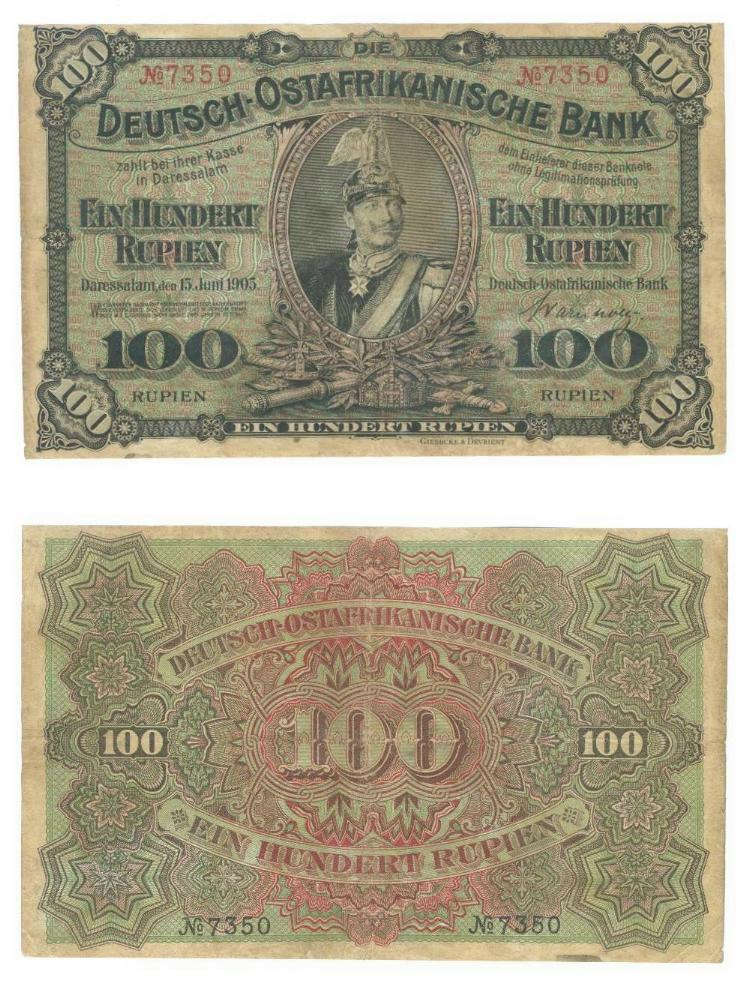
CASE # 0003. Liebe Sammlerfreunde,
die nachstehende Banknote der Deutsch-Ostafrikanischen Bank wurde mir im Januar
2002 auf dem Postwege gestohlen. Falls Du diese Banknote angeboten bekommst oder
Informationen über den Verbleib dieser Banknote hast, sende mir bitte umgehend eine
eMail.
Ist Dir ebenfalls eine Banknote gestohlen worden, sende mir aussagekräftige Daten
(idealerweise ein Bild oder die Seriennummer) dieser Banknote und ich werde die Daten
hier veröffentlichen!
Deutsch-Ost-Afrika
Vorkriegsausgabe der Deutsch-Ostafrikanischen Bank, 100 Rupien vom 15.6.1905,
4-stellige KN
ENGLISH: the following German East Africa 100 Rupien 15.6.1905 (Pick-4) (ser.# 7350)
banknote was lost by Deutsche Post in Germany (in January 2002).
die nachstehende Banknote der Deutsch-Ostafrikanischen Bank wurde mir im Januar
2002 auf dem Postwege gestohlen. Falls Du diese Banknote angeboten bekommst oder
Informationen über den Verbleib dieser Banknote hast, sende mir bitte umgehend eine
eMail.
Ist Dir ebenfalls eine Banknote gestohlen worden, sende mir aussagekräftige Daten
(idealerweise ein Bild oder die Seriennummer) dieser Banknote und ich werde die Daten
hier veröffentlichen!
Deutsch-Ost-Afrika
Vorkriegsausgabe der Deutsch-Ostafrikanischen Bank, 100 Rupien vom 15.6.1905,
4-stellige KN
ENGLISH: the following German East Africa 100 Rupien 15.6.1905 (Pick-4) (ser.# 7350)
banknote was lost by Deutsche Post in Germany (in January 2002).
See also
10 Rupees / 10 Rupien
I am a serious collector of banknotes
specializing in '10 Rupees / 10 Rupien' of various countries including
German East Africa (GEA).
While searching the Google engine , I hit upon your site which I found to be very informative. However, I would like to know if you have any information pertaining to the banknotes . My Question would be
How many different Signatories (or Governors ) has the GEA '10 Rupien' been issued between 1905 - 1917 and what were its different types / prefixes.
I shall be grateful if I can get this information.
Thanking You Sincerely,
Percy Siganporia
Anyway, if you do come across information or even banknotes of '10 Rupien ' GEA or '10 Rupees' of Mombasa (East Africa) , Zanzibar , kindly let me know. I shall be truly grateful for the same.
While searching the Google engine , I hit upon your site which I found to be very informative. However, I would like to know if you have any information pertaining to the banknotes . My Question would be
How many different Signatories (or Governors ) has the GEA '10 Rupien' been issued between 1905 - 1917 and what were its different types / prefixes.
I shall be grateful if I can get this information.
Thanking You Sincerely,
Percy Siganporia
Wow, what an interesting hobby! I thought that Northern Tanzania was pretty specialised, but finding 10 Rupee bank notes must call for real dedication.
And it’s a shame that I cannot help you, because I don’t think that I’ve got anything in my collection which will give the kind of detail you want. Most books just say something like “the currency used to be the Rupee” and stop there.
My guess is that many of the sources you need will be in German, and that’s always a challenge for non-German speakers.
However, I’ll try to remember you request as I look arround, and if I see anything I’ll let you know.
I truly appreciate your fast response and your gesture in helping me in
the information I seek for my subject of specialization. As you rightly
said, there could be sources in German which can provide me with certain
detials of the '10 Rupien' banknotes issued between 1905 & 1917 by
GEA . It is a matter of time / efforts that one can get the information
they require, thanks to the internet.And it’s a shame that I cannot help you, because I don’t think that I’ve got anything in my collection which will give the kind of detail you want. Most books just say something like “the currency used to be the Rupee” and stop there.
My guess is that many of the sources you need will be in German, and that’s always a challenge for non-German speakers.
However, I’ll try to remember you request as I look arround, and if I see anything I’ll let you know.
Anyway, if you do come across information or even banknotes of '10 Rupien ' GEA or '10 Rupees' of Mombasa (East Africa) , Zanzibar , kindly let me know. I shall be truly grateful for the same.
